

The Biggest Business Fears Shaping 2026
An analysis of the fears shaping today’s business landscape, based on real discussions with founders and executives across different markets.

Business Development & Community Manager

On this page(7)
- Global business trends and risks for businesses leaders are already facing
- Fear 1: Falling Behind in the AI Race
- Fear 2: Regulation Turning Technology Into a Risk
- Fear 3: Cyber Security Risks for Businesses
- Fear 4: Economic Uncertainty and Wrong Timing
- Fear 5: Talent Constraints Limiting Execution
- What These Fears Really Say About 2026
Global business trends and risks for businesses leaders are already facing
Business leaders headed into 2026 are operating in an environment where decisions carry more weight than before. Business trends insights (from my observation) show that the pressure does not only come from competition, but from uncertainty, speed of change, and the complexity of running a business across technology, regulation, and markets. This is something I keep hearing again and again in conversations with founders and executives in the US.
Fear 1: Falling Behind in the AI Race
Artificial intelligence sits at the center of most global business trends, but it also creates pressure few leaders talk about openly. Many fear that slow adoption will leave them behind competitors who move faster and experiment more aggressively.
At the same time, there is growing concern around AI risks for businesses when implementation happens without clear ownership, data readiness, or defined outcomes (our research here). In many leadership conversations, the issue is not whether to use AI, but how businesses manage risks of AI implementation so that AI supports the business instead of complicating it.
Fear 2: Regulation Turning Technology Into a Risk
Regulation has moved from a legal topic into a strategic one, especially in areas related to AI and data. Leaders worry that systems built today may face compliance issues tomorrow as rules continue to evolve.
This uncertainty creates hesitation, particularly for companies operating across multiple markets. European businesses in particular are becoming more cautious about investing in technology that could later require costly changes or legal restructuring, especially when operating internationally. That’s why many of those businesses are actively thinking about expanding to the US (and that’s why we at Moravio did it).
Fear 3: Cyber Security Risks for Businesses
Cyber threats are now viewed as a realistic scenario rather than an unlikely event. Data breaches, ransomware attacks, and infrastructure failures can disrupt operations overnight and damage trust built over years.
What worries leaders most is not just the financial loss, but reputational impact and long-term credibility. Cybersecurity is increasingly discussed at leadership level as a core business risk, not something that can be fully delegated to IT teams. I can see this repeat over and over again, from NYC to LA.
Fear 4: Economic Uncertainty and Wrong Timing
Economic conditions remain unpredictable. High interest rates, cost pressure, and volatile demand make it difficult to decide when to invest and when to wait.
Many leaders fear committing resources too early or holding back for too long. This often leads to cautious strategies that protect cash but can slow growth if not managed intentionally.
Fear 5: Talent Constraints Limiting Execution
Business trends insights from recent years show that even the strongest strategies depend on people. Skill shortages, especially in AI and advanced digital roles, continue to limit execution across industries.
In practice, this fear often pushes companies to rely more on external partners to maintain delivery speed and quality. The concern is not cost, but whether the business can actually execute on its plans at the required pace.
What These Fears Really Say About 2026
When I talk to founders and executives at events all over the US, fear is rarely named directly. What comes up instead is careful thinking, selective decision making, and an effort to avoid moves that could quietly slow a company down for years.
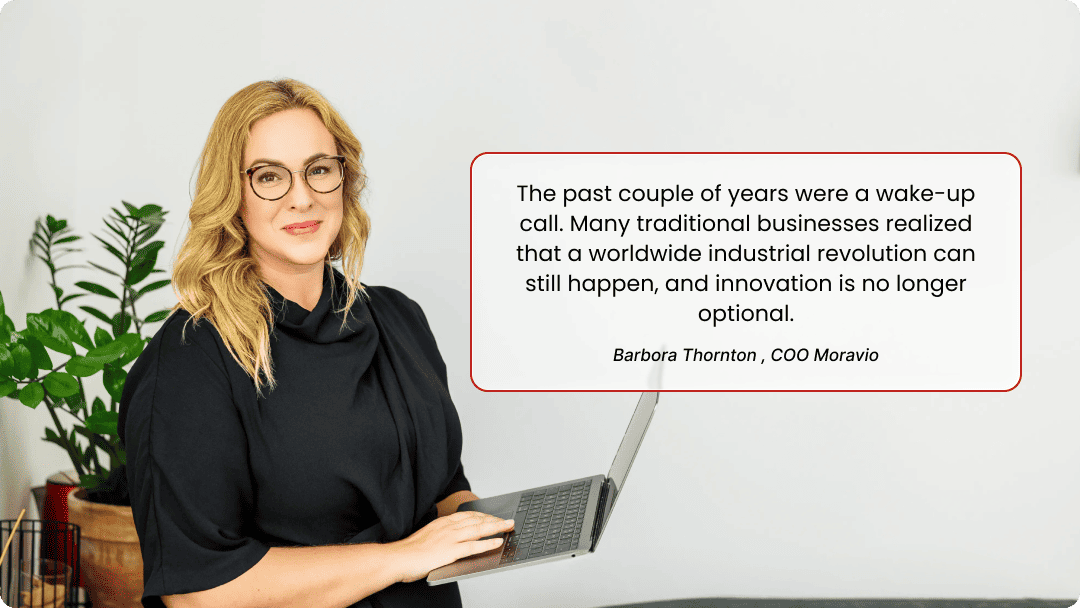
The past few years were a clear wake-up call for many traditional businesses. When we discuss this within the Moravio team, our COO Barbora often captures it well: even well-established industries are not immune to rapid, global shifts, and innovation can arrive much faster than expected. The assumption that a business can run unchanged until owners or managers retire is fading, with more conservative companies now seeking technological updates simply to stay relevant.
This is where a different approach to innovation matters. Not every company needs massive budgets or radical transformation. Many start with small, targeted automations that deliver value gradually, reduce risk, and build confidence for future steps without disrupting the core business.
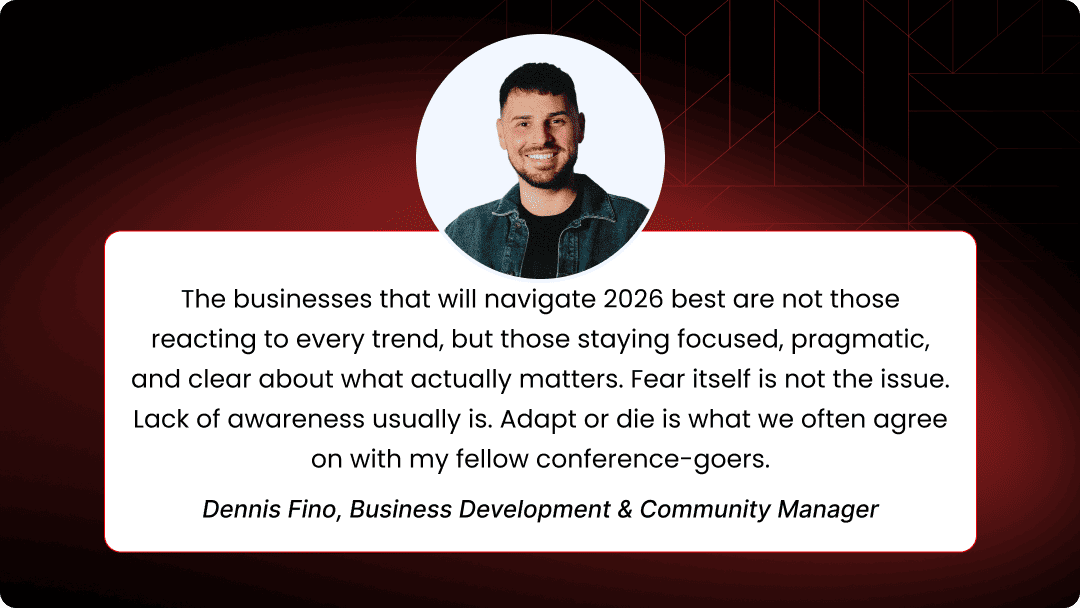
The businesses that will navigate 2026 best are not those reacting to every trend, but those staying focused, pragmatic, and clear about what actually matters. Fear itself is not the issue. Lack of awareness usually is. Adapt or die is what we often agree on with my fellow conference-goers.
Industries

New Articles
New blog posts you may be interested in

Quote automation for manufacturers: what changed in the last year
Manufacturers do not lose days on quotes because pricing is hard. They lose them because someone has to turn drawings, emails and spreadsheets into a clean list before pricing can even begin. That manual step is finally small enough to automate.
Read more
Finance + Operations Alignment: What Actually Improved
When finance and operations run in separate realities, companies usually pay twice, first in time, then in errors. This case explains what improved after aligning dispatch, document flow, and invoicing readiness.
Read more
What Changed After Moving to Reservation Lifecycle Control
This case outlines practical change after moving from volume-push behavior to controlled reservation lifecycle management. The goal was not another dashboard. The goal was to change operational decision quality over time.
Read moreRead also
Recommended reads for You
Quote automation for manufacturers: what changed in the last year
Manufacturers do not lose days on quotes because pricing is hard. They lose them because someone has to turn drawings, emails and spreadsheets into a clean list before pricing can even begin. That manual step is finally small enough to automate.
Read more
How companies lose control: too many tools, too many Excels, too many versions of the truth
Many companies don't screw up their digitalization by doing nothing. Quite the opposite. They gradually buy a series of tools, each of which solves a small part of their operation. But over time, they discover that instead of one functional system, they have fragmented processes, unreliable data, and people who keep their own Excel spreadsheets to themselves just to be safe.
Read more
Why Do Digital Transformation Projects Suffer such High Failure Rates?
Digital transformation is a priority for many companies, yet most initiatives still fail to deliver the expected results. Based on Moravio’s hands-on experience and insights shared by Dennis Fino, this perspective reflects what teams often overlook long before technology becomes the issue.
Read moreMore context helps
Describe the situation
A few useful details help us prepare: who is affected, how the work happens today, what has already been tried, and why this matters now.