

The “AI readiness” index on the market is 40% - Moravio Research
Most companies are not ready to integrate AI. We did our own check of how ready companies are, and in this article we explain how we measured it and what the main problems are.

Head of Marketing
On this page(14)
- Everyone wants AI, but is everyone actually ready for it?
- How we calculated the AI readiness index for companies
- 8 important points we selected to check AI readiness and why they matter
- Our comments, thoughts and insights on these AI readiness points
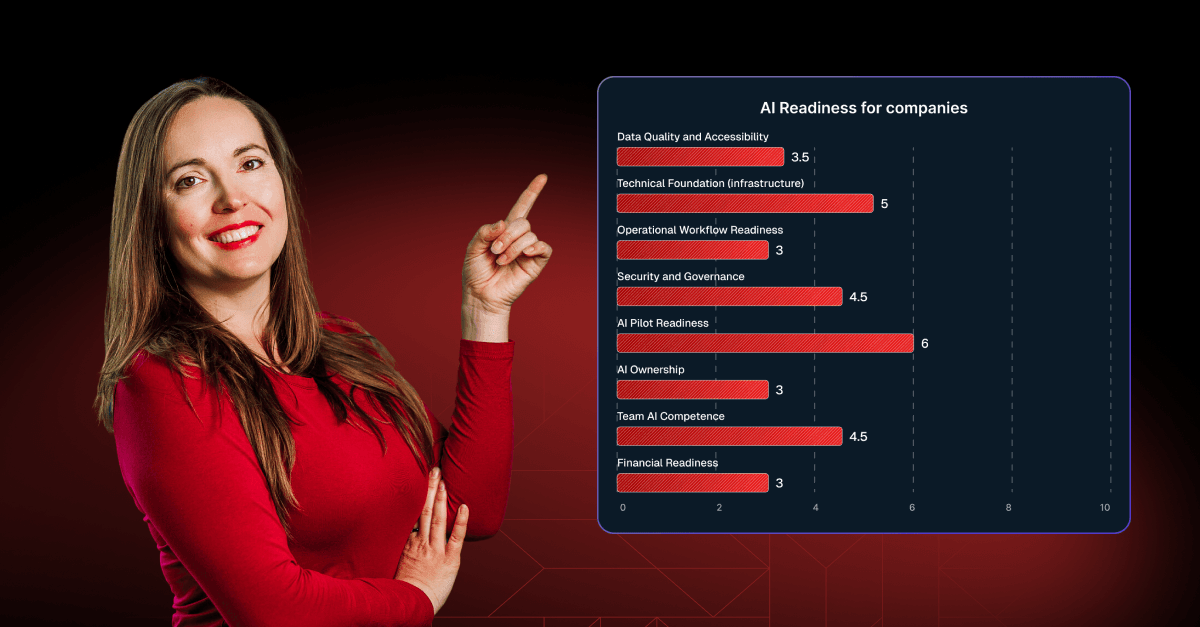
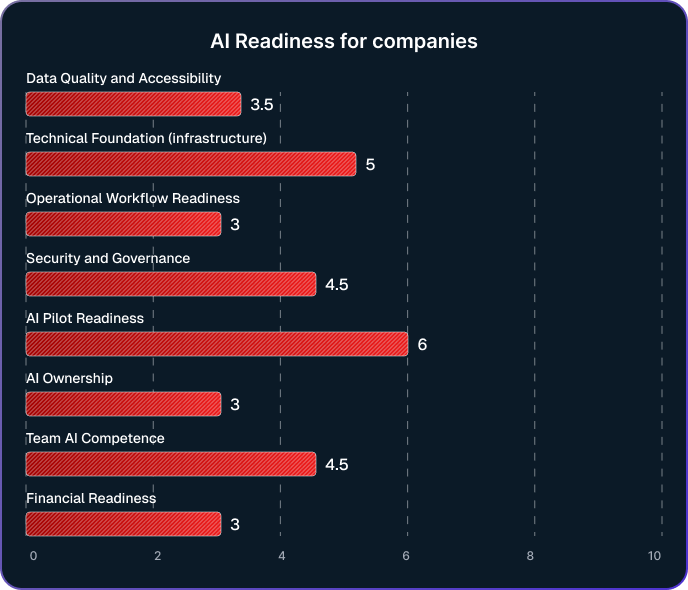
- 1. Data Quality and Accessibility (Data maturity) - 3.5/10
- 2. Technical Foundation (AI-ready infrastructure) - 5/10
- 3. Operational Workflow Readiness - 3/10
- 4. Security and Governance (Security & compliance readiness) - 4.5/10
- 5. Pilot Readiness (Ability to launch first AI use cases) - 6/10
- 6. AI Ownership (Decision leadership for AI) - 3/10
- 7. Team AI Competence (Team AI literacy) - 4.5/10
- 8. Financial Readiness (Investment readiness) - 3/10
- General results in a table format
- A few important things to add
This article is a collective view from our team. No long explanations about why AI matters, just real cases from real businesses showing what AI readiness looks like today. We also share our overall view of the market. You may recognize your own situation here, but it’s better to prepare now than spend a lot of resources later and still get no real results. Let’s go.
Everyone wants AI, but is everyone actually ready for it?
AI has become so common in our daily work that many companies now feel constant pressure to add it, otherwise they risk losing their place on the market. And sadly, that part is true. But before bringing AI into your internal processes, there are three very important things you need to understand:
AI doesn’t create magic or replace your entire workload. It can significantly speed up your processes, but only when there is clarity around how the work should be done and what outcomes you expect.
AI in the hands of skilled people can bring real value to the business. But in the hands of people who don’t know how to use it, AI can cause damage for business - lost time, wrong decisions, security risks, even harm to your reputation.
Before adding AI, it’s important that the company, processes, and people are ready for it. That preparation helps avoid unexpected challenges and sets the ground for meaningful results.
And this third point is exactly where I want to focus. Over the past year, we received many requests that sounded like “we need AI. ” After talking to many companies and visiting events across the EU and the US, we created our own AI readiness index based on what we see happening on the market.
Below you’ll find how we calculated this score, but here’s the short spoiler: most companies are not ready for AI. If they add AI into their processes tomorrow, it might not work as initially planned. And what’s even more important - many companies don’t realize how critical AI readiness is or what risks they face without it.
How we calculated the AI readiness index for companies
To calculate the score, we ran an internal survey with our colleagues who work with projects and partners every day. What’s interesting is that the answers were very different - there was no single trend. But we want to highlight the most common problem areas to help your business avoid issues and extra costs in the future.
It’s important to say that this article reflects the experience of our whole Moravio team across projects of different sizes and complexity. This is our view at the end of the year, moving into 2026, based on what we see when companies talk about AI integration today.
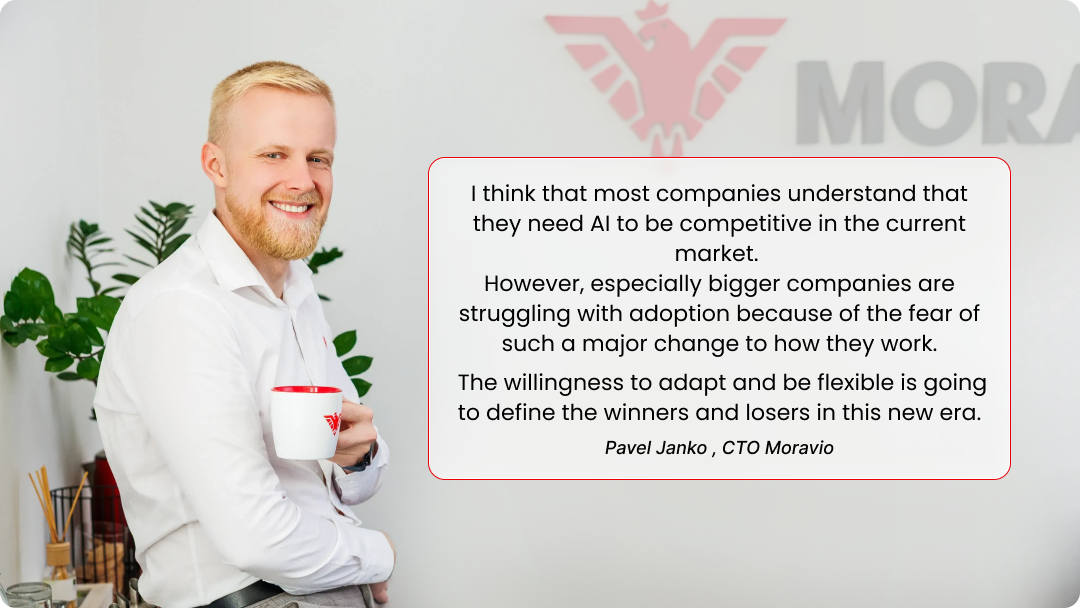
Pay attention to these points - they show different pain areas companies face. We share them so you can spot them early in your own business. If you ignore them, you risk losing time and money. Some points may not apply to small businesses, but we included them because they are critical for larger companies and corporations.
8 important points we selected to check AI readiness and why they matter
| Point | What it means | Why it matters |
|---|---|---|
| Data Quality and Accessibility | How clean, structured, accessible and usable the data is. | AI only works well when the data is in order. Bad data means wrong AI results. |
| Technical Foundation (infrastructure) | How well the company’s systems and infrastructure can integrate AI. | Without modern infrastructure, AI can’t be connected or scaled. |
| Operational Workflow Readiness | How stable, predictable and clear the processes are. | AI can automate only well-defined, repeatable workflows. |
| Security and Governance | The maturity of access rules, security, policies and compliance. | AI increases risk, so companies need the right rules in place to keep data protected. |
| AI Pilot Readiness | Having clear processes or ideas where AI can be tested quickly. In other words, having a clear idea of WHERE to start with AI. | The first small pilot shows real value and allows you to move forward without risk. |
| AI Ownership | Having a responsible person or team making decisions about AI. It is clear who is responsible for what regarding AI integration. | Without an AI owner, initiatives stall, get lost, or don’t move forward. |
| Team AI Competence | How well the team understands AI, uses it in daily work, and knows the basic algorithms, risks and safety rules. This also includes the team’s readiness to learn. | Even the best solutions won’t work if the team is not ready to use them and resists change. |
| Financial Readiness | Readiness to invest in AI in the next 12 months. | AI brings ROI, but it still needs initial investment in pilots, infrastructure or training. |
We also rated each point from 1 to 10, where 10 means fully ready and 1 means not ready at all. But from project to project and client to client, the results were very different. So we took the median values.
Our comments, thoughts and insights on these AI readiness points
1. Data Quality and Accessibility (Data maturity) - 3.5/10
Most companies already store data in some structured form, but the way it’s organized often leads to duplication and limited accessibility. Data is scattered across tools, and many firms still run on legacy or even paper-based systems, so a big preparation step is needed before using AI. Sensitive data is usually well protected, but datasets often require cleanup. People also expect more from AI than their current data can realistically support.
Best thoughts from Moravio team
| Team member | What we see in practice |
|---|---|
| Hsinyu Ko | Either scatter across tools or it requires a lot of effort to restructure. |
| Jakub Bílý | Following discussions with clients, we often find that they do not have sufficient data prepared for the use case where we want to use AI, or they do not have any data at all. This is then one of the first steps that must be taken before implementing AI into the company processes. |
| Pavel Janko | Most clients already have their data in some structured format (databases, Google Sheets), but the problem is that the way they are structured usually leads to duplication and other inefficiencies. Another issue is that this data is rarely accessible for external integration, making improvements harder to achieve. |
| Dennis Fino | The data are often not quite ready and still require human review and check. |
| Barbora Thornton | Clients have multiple sources for the same data, sources are not consistent, and mainly not up to date. There's a lot of manual work in transferring or copying data, so you can get different answers for the same question (depending on the person and time). Even something clearly exact - like warehouse items - could be misinterpreted |
2. Technical Foundation (AI-ready infrastructure) - 5/10
Most companies use tools that support integrations and have basic APIs, so connecting systems is usually possible. Smaller companies tend to be flexible, while mid-sized and larger ones are often slowed down by legacy systems and strict security rules. Moving to the cloud helps, but it’s not enough on its own, and many infrastructures still can’t scale well for AI. Sometimes outdated internal systems without APIs require custom workarounds before AI can be added.
Best quotes from our team
| Team member | What we see in practice |
|---|---|
| Lukáš Gren | As the management of some of our clients is technically adapted, they made good choices a few years ago, creating a well interconnected ecosystem of designated apps that can communicate in and out easily. |
| Hsinyu Ko | Almost all our clients are open to AI integration and the tools they're using mostly support that. |
| Jakub Bílý | This is very specific to each client. In most cases, clients already have some form of API today, so it is possible to connect to their systems. Of course, there are also cases with a relatively outdated internal system that does not have an API and is still in use, and in such cases, we have to figure it out and find a smart solution. |
| Pavel Janko | I would say that for smaller companies, this isn't as much of a problem, because they are more flexible in terms of which technologies they use inside their company. However, mid-sized (100+) and larger companies are typically significantly more rigid and bogged down with legacy infrastructure and oftentimes also constrained by excessive security requirements. |
| Barbora Thornton | That depends heavily on the industry and the founders/management/owners' digital enlightenment. A lot of legacy problems are carried on. That could go both ways, sometimes starting fresh is better than trying to integrate a lot of obsolete digital solutions. Sometimes it is better to have data in excel than in 20 different tools. |
3. Operational Workflow Readiness - 3/10
Many businesses lack clear workflows. Also readiness varies by industry: some areas have predictable steps, while others are complex with many exceptions. In most cases, clients need workflow revision before AI. Working through the process with them usually helps clarify what can be standardized. Fully well-defined processes are rare, but repeating tasks are generally suitable for automation.
Best thoughts from Moravio team
| Team member | What we see in practice |
|---|---|
| Jakub Dolba | Often many happy-path processes are defined, but there are so many edge cases "which are solved on the fly" |
| Pavel Janko | It happens very rarely that a client has well documented and overall well defined processes. |
| Barbora Thornton | In the corporate world, workflows rule. In smaller companies, they are almost optional. Neither of that is good. Corporates are usually locked in some big solutions (like Microsoft 365, SAP or some ERP), so the workflows can be dictated by them, as well as AI adaptation. Again, smaller companies might be a little more free of defined workflows (or don't have them captured) and relying on the human factor. |
| Jakub Bílý | I think this is also one of the most common problems we encounter. Clients do not have clearly defined processes, or they have quite a few edge cases that are not so easy to resolve from the first glance. In both cases, it is possible to work with this and resolve it. In the first case, when the client describes the process itself, it also helps the client to clarify what they are doing and how, and whether it can be improved. In the case of specific edge cases, we go into more depth and discuss whether we can standardize them in some way, how often they occur, how much sense it makes to address each of them, and then we approach a solution that makes sense for the client and has some return on investment. |
4. Security and Governance (Security & compliance readiness) - 4.5/10
When it comes to data security, most companies pay attention to it, and the bigger the company, the stricter the policies usually are. However, many people still use tools like ChatGPT without understanding data protection risks.
Some businesses rely mainly on the built-in security of the products they use, and legal or compliance topics are often not discussed at all.
Security is sometimes used as a reason to delay AI adoption , even when the actual risks are manageable. Newer systems often include better auditing, but overall AI-related governance is still not well established.
| Team member | What we see in practice |
|---|---|
| Hsinyu Ko | The larger scale of the company, the more comprehensive policy they have. |
| Pavel Janko | I think that companies are actually focusing on this too much even when not strictly necessary. From my point of view the security argument is something that is used by companies to have something to blame for why they are so behind when it comes to AI adoption. |
| Lukáš Gren | Most people are counting on the security of products they use. |
| Barbora Thornton | I would say - again, depends on the industry. But in general, if they need to control compliance and security, they do (in some degree). This is very often ensured by third parties (quality management and certifications, big cloud and hardware providers are coming with their own security protocols etc.) The reality is there are more things working on paper than in reality, so they might have the processes - but if they follow them, that's a different story. |
| Olga Topal | In large companies this is usually handled well because they have legal teams who take care of it. But from my experience (both with AI and advertising), small companies often don’t have their own legal department and don’t even realize what risks they take when using general AI tools. |
5. Pilot Readiness (Ability to launch first AI use cases) - 6/10
Interest in AI pilots is high, but maturity is mixed. Some companies have clear ideas, others only know that they want AI and need our help to find realistic use cases.
There are almost always quick win pilots we can launch after a short feasibility check, even if timelines depend on their internal processes and people, while for our own operations we can test and ship small AI improvements very fast.
| Team member | What we see in practice |
|---|---|
| Jakub Bílý | It depends on many factors. We talk to companies that already have a good idea of where they would like to use AI. And then we have companies that come to us and say, "Can you meet with us, go through our operations, and work with us to determine where it would be appropriate for us to use AI?" And we also have cases where companies have an idea of where they would like to use AI. We do a feasibility workshop, and ultimately find that it would be better to use AI somewhere else entirely. In any case, we always try to find some smaller, so-called "quick win" projects where we can test the use of AI or automation with the client and build from there. |
| Pavel Janko | There are almost always some quick wins that can be achieved through the implementation of AI, however, the deliverability timeline tends to be longer because of factors on the client's side. |
| Hsinyu Ko | Most of the clients are asking or willing to hear our suggestion regarding integrating AI tools to benefit their work. |
| Olga Topal | I see clear places in every company where small changes can make the work much faster and easier. But very often managers focus on other things. My advice to business owners: listen to the people who do the daily routine, not just tell them what to automate. They can give you insights you would never get otherwise. |
| Barbora Thornton | I would say high because AI use case can be very small, AI can automate mundane tasks with very little preparation needed (data, tools, compliance). AI can show value very fast, but to incorporate it to the depths of company processes, that can take longer, especially if connected to some software solutions update. AI is not a universal savior, can do small things really fast but the big ones - it pays off to have them done right than just as a wow effect. |
6. AI Ownership (Decision leadership for AI) - 3/10
AI leadership is still concentrated in one role, mostly the CEO, and proper ownership is missing. Some organizations rely fully on external experts, while others only start thinking about ownership after seeing a small working AI feature.
Larger companies are beginning to form dedicated AI roles or teams, and interest is growing fast as management pushes for AI adoption. In some cases, AI use is distributed across the whole company, with each person responsible for using AI in their work, but this model is still not common.
| Team member | What we see in practice |
|---|---|
| Barbora Thornton | AI is the biggest leap forward from the internet itself, but also a buzzword. Everyone wants to incorporate it but in a lot of cases the understanding of the real contribution to the business is very low. So I'd say hyped ownership 10 but informed ownership 2. |
| Hsinyu Ko | Unfortunately, till now, I only see a company that has an AI consultant role, the rest rely highly on external experts or don't even rely on any. |
| Jakub Bílý | Most companies don't have such a role and don't see a point in it. Today, this is changing dramatically, and at least large companies already have people or entire teams dedicated to AI transformation. |
7. Team AI Competence (Team AI literacy) - 4.5/10
AI literacy varies a lot. Younger or digitally oriented teams use AI tools daily and understand their limits, while others have only basic experience or no interest at all. Most companies don’t offer structured AI training, so knowledge grows mainly through personal use of tools like ChatGPT.
In some teams AI is already part of everyday work, and not using it means falling behind. In others, employees still wait to see “what AI can bring” and need guidance to understand how it can improve their workflow.
| Team member | What we see in practice |
|---|---|
| Barbora Thornton | Even companies as Deloitte and big law firms are using AI incorrectly (don't understand how it works) and relying on its results way too much. Like the internet does not mean Google, AI doesn't mean ChatGPT. And this shortcut is already deeply embedded in people's minds. New terms are emerging - AI psychosis, context poisoning, hallucination loops, prompt drift. It shows the growing gap between human expectations and AI's actual capabilities, where over-reliance leads to distorted decision-making and flawed outcomes. Yet. |
| Jakub Bílý | I feel that there is still a lot of room for improvement, and it also depends greatly on the type of company and role/job in question. I would venture to say that companies operating in the digital sphere are very advanced in terms of AI, are open to using new tools, and often test them. They also have a pretty good understanding of the current limits of AI and what can and cannot be created with it at this point. Then there are companies on the other end of the spectrum that are still just considering where to use AI, and their employees may only have a little experience with using an LLM such as ChatGPT or Gemini. There, we often encounter people who do not understand AI at all or do not even want to understand it. |
| Lukáš Gren | I think we are at a point where if you don't use AI, you are not catching up with the company speed. You'll be left behind. |
| Dennis Fino | There are some that know, and then there are some who are like expecting "what would AI bring". |
| Olga Topal | I still meet marketers from other companies who refuse to use AI tools because “AI has no soul” , and they avoid it as long as possible. This is not OK, it shows a lack of AI literacy. And if the management suddenly starts AI training, these people will become a blocker for the whole team . The second major problem is that people don’t believe AI can make mistakes . And there are already many cases among lawyers and other professionals where they trusted AI’s answers blindly and later faced serious issues for their business. |
8. Financial Readiness (Investment readiness) - 3/10
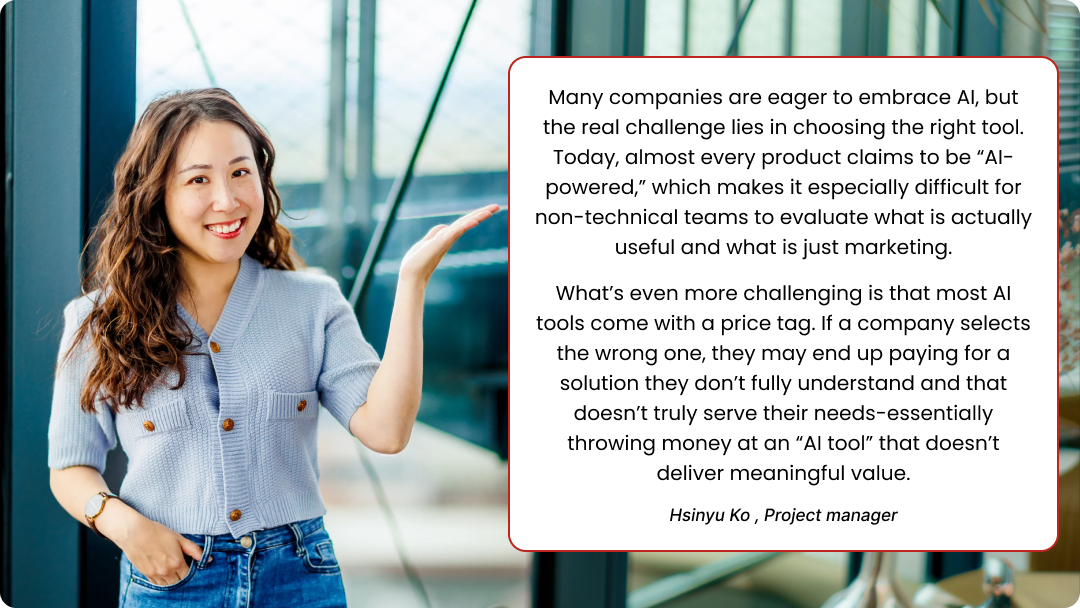
Most companies don’t have a dedicated AI budget yet. Interest in AI is growing, but investment decisions depend heavily on clear ROI. In many cases, discussions sound like “this could help us, let’s see what it would cost.” Dedicated AI funding exists only in rare cases, and many companies are still cautious or unsure where to invest.
| Team member | What we see in practice |
|---|---|
| Lukáš Gren | In some companies, like Moravio, the AI budget is the HR budget. We hire less people, so we have a budget to hire more AI. Sounds scary, but that's the global corporate reality. |
| Pavel Janko | The budget for AI is there, however, most companies need to understand the ROI very well, which is our job to explain to them. |
| Barbora Thornton | A lot of companies have allocated AI budgets and they can be quite generous. But it requires experts within the said company or externists to evaluate and allocate it reasonably. And if they just want to experiment - it's important to know that the ROI might not be positive. |
| Olga Topal | From a marketing point of view, many expect that a cheap AI tool will replace several people. But the truth is that good tools cost a lot, and cheap ones often produce low-quality results. Sadly, many managers still don’t understand this difference. |
General results in a table format
| Point | Median score | Comment |
|---|---|---|
| Data Quality and Accessibility | 3.5 | Data often structured but scattered, duplicated and not ready for AI. |
| Technical Foundation (infrastructure) | 5 | The tools they're using mostly support that. Basic integrations are possible, but scaling and legacy systems remain a barrier. |
| Operational Workflow Readiness | 3 | Workflows exist but are unclear, full of edge cases and need revision. |
| Security and Governance | 4.5 | Big companies are well prepared, small ones barely address AI security. |
| AI Pilot Readiness | 6 | Companies want AI but rarely know where to start, quick wins almost always exist. |
| AI Ownership | 3 | Ownership unclear, often external experts. |
| Team AI Competence | 4.5 | AI use varies widely, from daily users to people with almost no understanding. |
| Financial Readiness | 3 | No dedicated AI budgets yet, investments depend on clear ROI. |
| Final conclusion | 40% readiness | Many want AI but struggle to choose the right tools, especially with every product claiming to be AI powered. Budgets are limited, expectations are high , and bigger companies move slowly due to fear of major change. At the same time, early adopters already use AI daily and gain speed. With the right guidance and small, low risk pilots, companies can unlock real value instead of paying for tools that don’t fit their needs. |
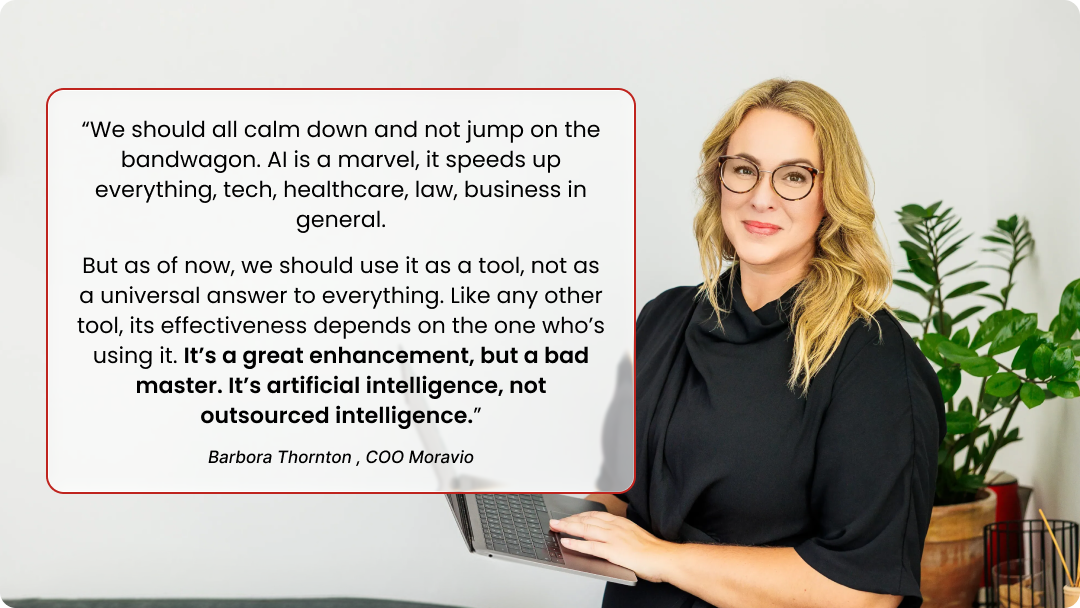
As our COO Barbora said:
"We should all calm down and not jump on the bandwagon. AI is a marvel, it speeds up everything, tech, healthcare, law, business in general. But as of now, we should use it as a tool, not as a universal answer to everything. Like any other tool, its effectiveness depends on the one who’s using it. It’s a great enhancement, but a bad master. It’s artificial intelligence, not outsourced intelligence."

A few important things to add
Each company is unique, and AI integration looks very different for small businesses and large ones. For smaller companies, even adding AI to basic daily tasks like handling customer inquiries can show results within a week. For corporations, it’s a complex process that needs time, money, employee training and more tools for proper integration.
But if you prepare for AI integration the right way, you’ll see real digital transformation and a clear boost in how your business works.
So the final answer is this: we see that most companies still have major gaps to fix before adding AI into their processes. But there is good news - we also see companies that already have automation in place, and even a small AI integration can help them speed up. Maybe that’s you?
And one more thing. We’ve already guided many different businesses through this journey – small and big, prepared and unprepared, with clean data or none at all. Our team knows how to understand your operations, highlight the right places to start, and shape AI solutions that actually fit your business. If you want to explore where AI can bring real value for you, we’re here to help.
Couple words from our marketing team
If this article was interesting for you and you want more research like this, follow us on social media (LinkedIn, Facebook, Twitter, Instagram) and send us a direct message - we will see it. And if you have specific topics you want us to cover, write to us as well and we’ll prepare material with answers to your questions.
Where did we get our inspiration? From the collective experience of our team and a detailed industry report by Cisco.
New Articles
New blog posts you may be interested in

Quote automation for manufacturers: what changed in the last year
Manufacturers do not lose days on quotes because pricing is hard. They lose them because someone has to turn drawings, emails and spreadsheets into a clean list before pricing can even begin. That manual step is finally small enough to automate.
Read more
Finance + Operations Alignment: What Actually Improved
When finance and operations run in separate realities, companies usually pay twice, first in time, then in errors. This case explains what improved after aligning dispatch, document flow, and invoicing readiness.
Read more
What Changed After Moving to Reservation Lifecycle Control
This case outlines practical change after moving from volume-push behavior to controlled reservation lifecycle management. The goal was not another dashboard. The goal was to change operational decision quality over time.
Read moreRead also
Recommended reads for You
Quote automation for manufacturers: what changed in the last year
Manufacturers do not lose days on quotes because pricing is hard. They lose them because someone has to turn drawings, emails and spreadsheets into a clean list before pricing can even begin. That manual step is finally small enough to automate.
Read more
How companies lose control: too many tools, too many Excels, too many versions of the truth
Many companies don't screw up their digitalization by doing nothing. Quite the opposite. They gradually buy a series of tools, each of which solves a small part of their operation. But over time, they discover that instead of one functional system, they have fragmented processes, unreliable data, and people who keep their own Excel spreadsheets to themselves just to be safe.
Read more
Why Do Digital Transformation Projects Suffer such High Failure Rates?
Digital transformation is a priority for many companies, yet most initiatives still fail to deliver the expected results. Based on Moravio’s hands-on experience and insights shared by Dennis Fino, this perspective reflects what teams often overlook long before technology becomes the issue.
Read moreMore context helps
Describe the situation
A few useful details help us prepare: who is affected, how the work happens today, what has already been tried, and why this matters now.