

Automating steel detailing: more projects without more drafters
A US steel-joist manufacturer wanted to run four to five thousand projects a year with thirty-five drafters instead of sixty. The bottleneck was never the steel — every shop drawing and every bill of materials was still drawn and typed by hand in AutoCAD.

This client operates under a strict NDA. We respect their privacy and protect their business secrets, so we can’t share details about the project.
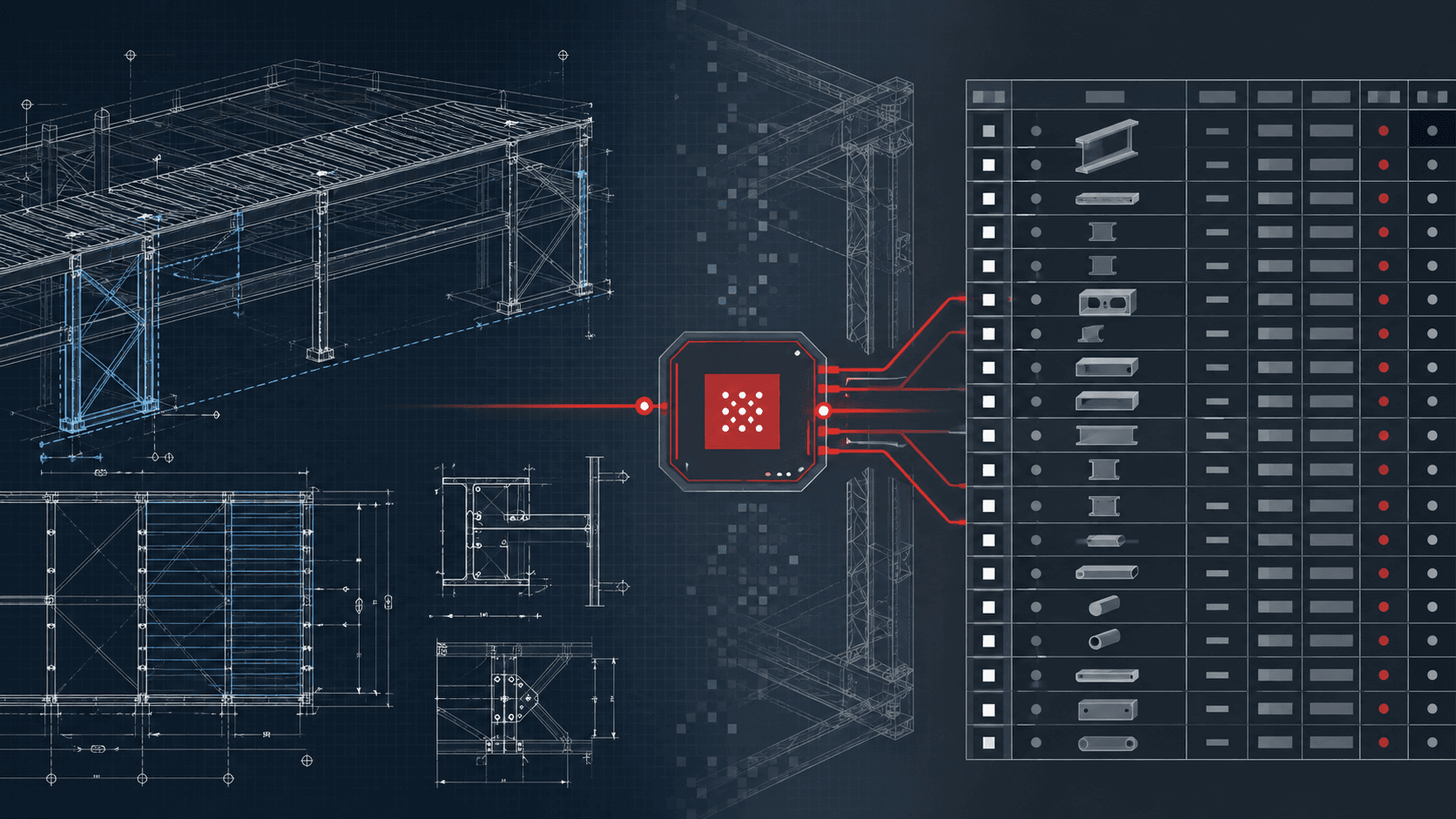
A steel fabricator with more work coming in
A steel-joist and metal-deck fabricator, scaling toward five facilities, with one plant alone targeting 170,000 tons a year. Its detailing runs through a partner drafting shop that works entirely in AutoCAD: joists, decks, beams, marks, and the bill of materials that drives fabrication. Fast-growing, owner-led, and already experimenting with AI on its own.
The real problem — too much of the work was still drawn and typed by hand
Growth was capped by manual drafting, not by demand. Every element — each beam, joist, section and dimension — is entered by hand, and the bill of materials is built the same way. One of their drafters had already wired an AutoCAD plugin with AI in about eighteen hours, which proved the idea worked, but it was brittle: as he pushed it further it kept breaking itself, fixing one thing and breaking another. They needed the concept industrialised so it would hold up under real project complexity. And there was a hard constraint underneath it all: by their own reckoning a single one-percent error in a bill of materials is a six-figure mistake, so the BOM has to be 100% accurate and pulled straight from AutoCAD, never estimated from an image.
We started with the process they already had
Before proposing anything we drew a hard line: do not rebuild AutoCAD, and do not throw away the work their drafter had already done. Our manufacturing lead asked to walk the whole process end to end — the customer input file, the desired output, and everything in between — and we framed a two-week discovery to define the first work package. The principle we led with was not one big project but a set of small steps: start with the boring, high-volume work that is safe to automate, and leave the expert judgment to the humans.
The plan: improve AutoCAD work, not replace it
We did not come back with a platform. We came back with a system in four parts, sequenced so that the first one earns its keep before the next one starts:
A full .NET AutoCAD plugin, built to be maintained rather than patched — a proper replacement for the homemade script, with smart lines and a shared section library so that a section drawn once is a section everyone reuses.
Automated BOM generation, read straight out of the AutoCAD model and exported to Excel in the shape the fabrication floor already reads, with the accuracy the floor cannot compromise on.
A central system holding projects, files, versions and a structured BOM database, with an AI layer on top that gets better as the underlying models get better, without anyone rewriting the plugin.
Two independent but connected systems, because the fabricator and the drafting shop are two separate companies with two separate sets of books, and pretending otherwise would have broken on the first invoice.
The whole thing sits alongside what they already run. Nothing is ripped out, nothing is migrated over a weekend, the code belongs to the client, and there are no licences and nothing to be locked into. That was deliberate. A shop that has already watched one automation attempt fall apart does not need a second thing that only one vendor understands.
The targets we designed against
The numbers here are the ones the client put on the table, and the constraints the architecture had to hold to.
In the near term they wanted drafting 40–50% faster, and they wanted it from the first automated modules rather than from a finished platform two years out. Further out, the ambition was three to five times the throughput with a drafting team that grows far more slowly than the order book does — the whole reason they started looking in the first place.
And then the one that shaped every technical decision: the bill of materials has no tolerance at all. At their volume a one-percent error is a six-figure mistake, which is why the BOM is read from the model itself and never inferred from an image of a drawing. Everything else in the architecture could be argued about. That could not.
What made this harder than a normal automation project
Two honest moments shaped this engagement, and both of them were their lead builder's doing.
The first was when he asked, straight out, how much AutoCAD work we had behind us. We told him what was true. Extending AutoCAD itself was not something we had done recently — our CAD-adjacent work sits closer to product configurators and quoting driven by engineering geometry — and what we would be leaning on here was .NET, AI, and a two-week discovery that proves the first module before anybody commits to a build. Saying that cost us nothing and bought us the rest of the conversation.
The second was when he pushed back on the idea of reading a bill of materials off a PDF image. He was right, and we agreed on the spot. The real BOM comes out of the plugin at full confidence or it is not a bill of materials, it is a guess with a table around it. It is a good sign when the person who knows the process best is the one tightening your requirements.
Turn engineering work into a system with Moravio
More projects should not automatically mean more manual drafting, more spreadsheet checks and more handovers between teams. We work with manufacturers to identify the repetitive, high-volume parts of the process and turn them into practical internal software — without replacing the systems that already work.
Start small: one workflow, one module, one measurable bottleneck. Explore workflow automation or build a custom internal system. Contact us.
These images were modified to comply with the client's NDA. The software interface remains unchanged.
 Generative AI
 Large Language Models
 C# and .NET
  React
React TypeScript
Industries

Featured Case Studies
Projects that might be interesting to you
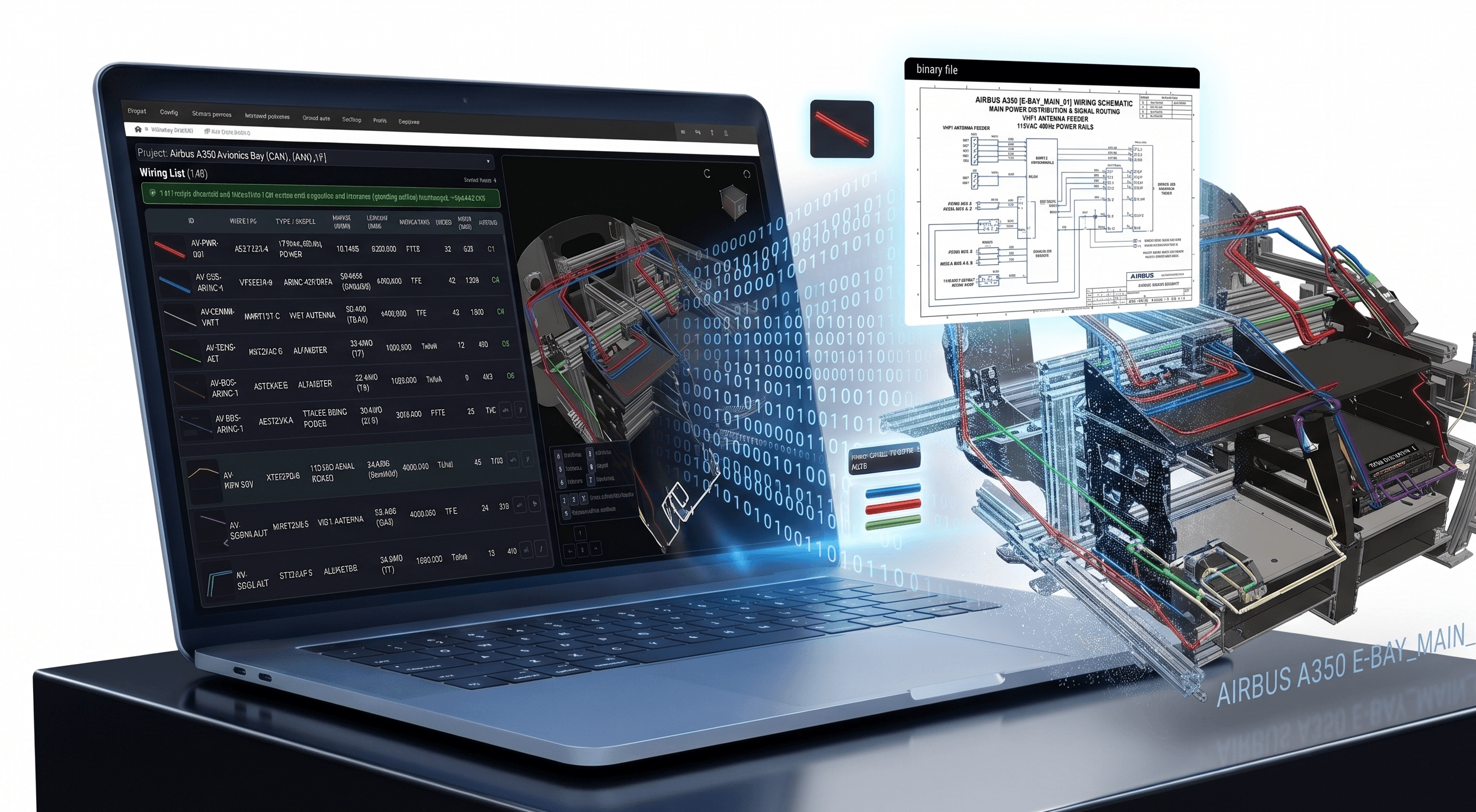
Quoting wire frames: from half a day per frame to about 15 minutes
An automotive supplier that bends wire and welds seat frames now breaks down a new frame in about 15 minutes. Before, the same analysis took half a day to a full day of manual clicking per frame - and a project can carry twenty of them.
View Case Study
How we helped Nokia Bell Labs
Nokia Bell Labs is one of the world’s most prestigious research institutions, boasting a 100-year legacy of ground-breaking innovations. For Moravio, partnering with such a renowned organization was both an honor and a challenge. Our mission was to convert cutting-edge research into a fully functional product, while allowing the Nokia Bell Labs team to focus on what they do best - pushing the boundaries of innovation.
View Case Study
A digital twin for automated warehouses: the numbers before the investment
Four aisles or five? One crane or two? A different picking strategy? A European manufacturer of automated warehouse systems can now test these decisions in a simulation and read the answer in pallets per hour — before a single rack is ordered.
View Case Study











More context helps
Describe the situation
A few useful details help us prepare: who is affected, how the work happens today, what has already been tried, and why this matters now.