

Quote automation for manufacturers: what changed in the last year
Manufacturers do not lose days on quotes because pricing is hard. They lose them because someone has to turn drawings, emails and spreadsheets into a clean list before pricing can even begin. That manual step is finally small enough to automate.

Head of Marketing

On this page(8)
- Why we are writing this now
- The same room, five times
- What smart RFQ automation is actually competing with
- Why “AI reads your drawings” is still the wrong promise
- What quote automation for manufacturing looks like when it works
- The buyer’s side of the same document
- What owners actually ask for
- The next quoting advantage will not wait
One scene repeats in almost every manufacturing company we walk into, whatever they make.
A large tender lands on a Monday morning. Eighty drawings, an email asking for prices at 1, 10, 50, 100 and 300 pieces, and a deadline that assumes you already have your numbers.
Before anyone can price anything, one person has to open every drawing and write out what is in it: every frame, leg, fitting, socket and rail, line by line, into a costing spreadsheet. That part takes about two days. Pricing the finished list takes about two hours.
Automation for manufacturers has been part of our work for most of the 14 years we have been building software for companies like this. What changed in the last year is not the problem. It is what it costs to solve it.
Why we are writing this now
A year ago, when a manufacturer asked us whether a machine could pull that item list straight out of the drawings, our honest answer was: possible, but slow, expensive and closer to research than a practical first step.
Reading arbitrary production drawings meant building a recognition system from scratch. It had to be taught on that plant’s own drawings, worked only there, and the next company would have to pay for the whole thing again. That is a research project with a research budget, not a product you can buy.
Four things moved since then.
General-purpose AI models now read a drawing page as an image and as text at the same time, and they can fill a fixed set of columns, not just return a block of text.
A whole tender folder goes in at once, instead of one file at a time.
The cost of processing a document fell far enough that running eighty drawings is an operating expense, not a capital project.
The choice of model became a configuration setting, not an architectural commitment. You are not betting the project on one supplier.
The fifth change is on our side. New tooling lets our developers move faster where it is safe to do so, without giving up quality, so what would have been a multi-month project a year ago now fits into a much smaller first step. That is why this is no longer only for large plants. A shop with a single estimator can now try it on its own tenders.
The same room, five times
That change only matters if the problem is real and repeatable. We are not extrapolating from one project. We keep seeing the same quoting bottleneck in different manufacturing companies; the examples below are only a few of them.
The company is different every time. The scene is not.
A wire-forming supplier. Frames were broken down by hand, item by item. That breakdown now takes about 15 minutes instead of half a day, and the wire-frame quoting build shows how it was put together.
A maker of custom interiors for offices and retail roll-outs. They bid through multi-round tenders where the first job is not pricing, but transcription: eighty drawings, two days of item breakdown, and only then two hours of pricing. When the tender returns in a revised version, much of that manual work starts again.
A contract manufacturer building single-purpose machines and robotic cells. Every bid begins with expensive manual preparation, and the owners are the first to say the hit rate does not justify the effort. The information an estimator needs — client history, volumes, technology, what the plant can do in-house — exists, but it is scattered across systems, so a senior person spends the morning gathering instead of deciding.
A family sports-equipment maker selling from its own shop and through dealers. The whole path from incoming request to quote to production lives in email inboxes, with dealer terms and direct terms mixed into the same thread.
An automotive components supplier, meeting the same document problem from the other side of the table: purchasing.
Different products, one bottleneck. Our work in manufacturing covers the wider picture.
What smart RFQ automation is actually competing with
Across those examples, the pattern is the same: the hard part is rarely the final calculation. The bottleneck is everything that has to happen before calculation can even start.
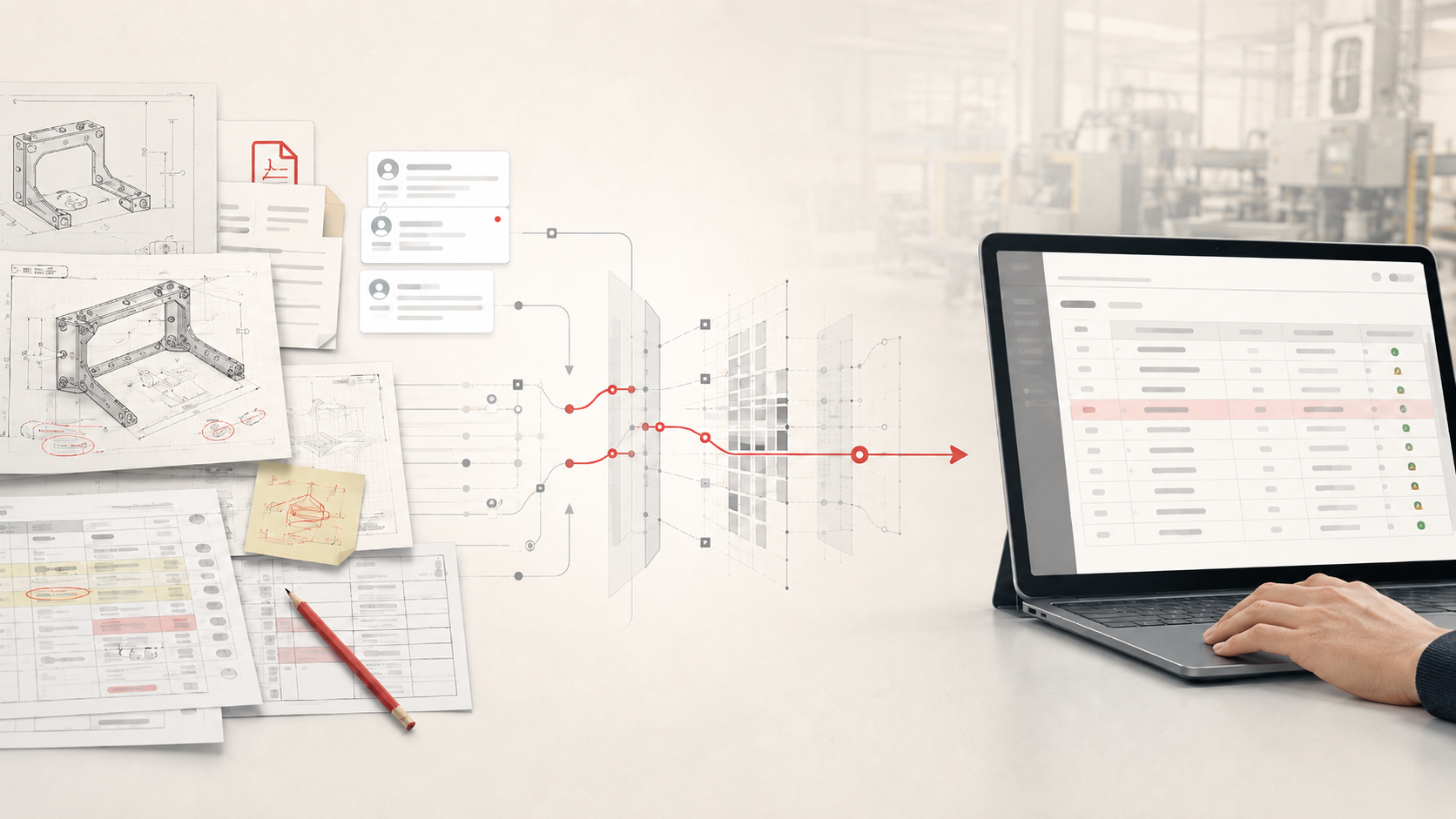
Pricing a finished list is routine work for an experienced estimator. Reading eighty drawings and typing out the bill of items is not difficult; it is just long. And it has four expensive side effects.
The method lives in one head. The whole approach sits with one senior person. The owner’s options are to hire a second estimator and train them for years, or to invest once in software that takes over the boring half.
The expert is pulled off the work that pays. High-volume, low-judgment work crowds out the complex projects where their experience actually earns money.
Revisions cost as much as originals. Tenders arrive in versions. Every reissue means the transcription is done again, by hand, from the start.
Prices go stale quietly. In most shops the real price depends on quantity, order type, project agreement and date. Pulling numbers automatically from an accounting system without that context imports last year’s pricing into this year’s bid.
Underneath all four sits the same thing we find in most of these companies. The process runs on spreadsheets. Excel is where quoting lives, and it is usually the first thing that has to become a system before anything else can be automated. We saw the same shape in construction, where the estimating desk was rebuilt into a construction quoting system.
Why “AI reads your drawings” is still the wrong promise
Production drawings are not standardised input. They come from different clients, in different formats, with different habits, languages and assumptions baked into the file. An AI model will not reliably read any drawing you hand it: a shape on a page can be a table leg or a pipe, and nothing in the file says which. No model is right one hundred percent of the time, on any document.
So the honest scope is narrower, and far more useful: the model drafts the item breakdown from large, well-documented tenders, and a person checks it. That is not a compromise. It happens to be exactly the case that hurts most, because the biggest tenders are usually the ones with the best documentation.
This is the difference between selling the broad promise and building the useful version of it. The broad promise would try to read every drawing and hide the uncertainty. It would make a better demo than a working quoting process. The useful version is narrower: it drafts the item breakdown where the documentation is good enough, shows where it is unsure, and leaves the estimator in control.
What quote automation for manufacturing looks like when it works
Once the scope is honest, the design becomes much simpler. The system should not pretend to replace the estimator; it should make the estimator’s review faster, clearer and easier to trust. In practice, that means five rules.
A batch, not a chat. The whole tender folder goes in, drawings and the inquiry text together, and a structured table in your estimator’s own format comes out. Nobody feeds files into a chat window one by one. Re-running a revised folder then costs machine time instead of another two days.
Every page is read twice. Once as text, once as an image. Two readings of the same page catch what one of them misses.
Doubt is visible. Every row carries a confidence level and a reference back to the drawing it came from. Your estimator checks the flagged rows instead of re-reading eighty files.
Closed lists where it matters. Production type, material category and similar fields are chosen from your list. The model classifies, it does not invent.
Prices are suggested, never filled in silently. Where the system finds an item in your own records, it shows the price and how old that price is, and a person confirms it.
Two practical points usually come next. Where the numbers an estimator needs are scattered across systems, putting them in one place comes first, because nothing can draft from information nobody has collected. And for manufacturers where quoting still lives in email, the same step turns an inbox thread into a record you can follow from request to quote to production.
Custom automation for manufacturing is worth doing where the volume is high and the judgment is low. That is why we map the process before building anything, and why the first step is deliberately small. The same principle produced a steel detailing automation that turns CAD data into a bill of materials, and it applies to the wider workflow automation around the quoting desk. If your offer has to be assembled from options and rules rather than extracted from drawings, that is what custom CPQ software is for.
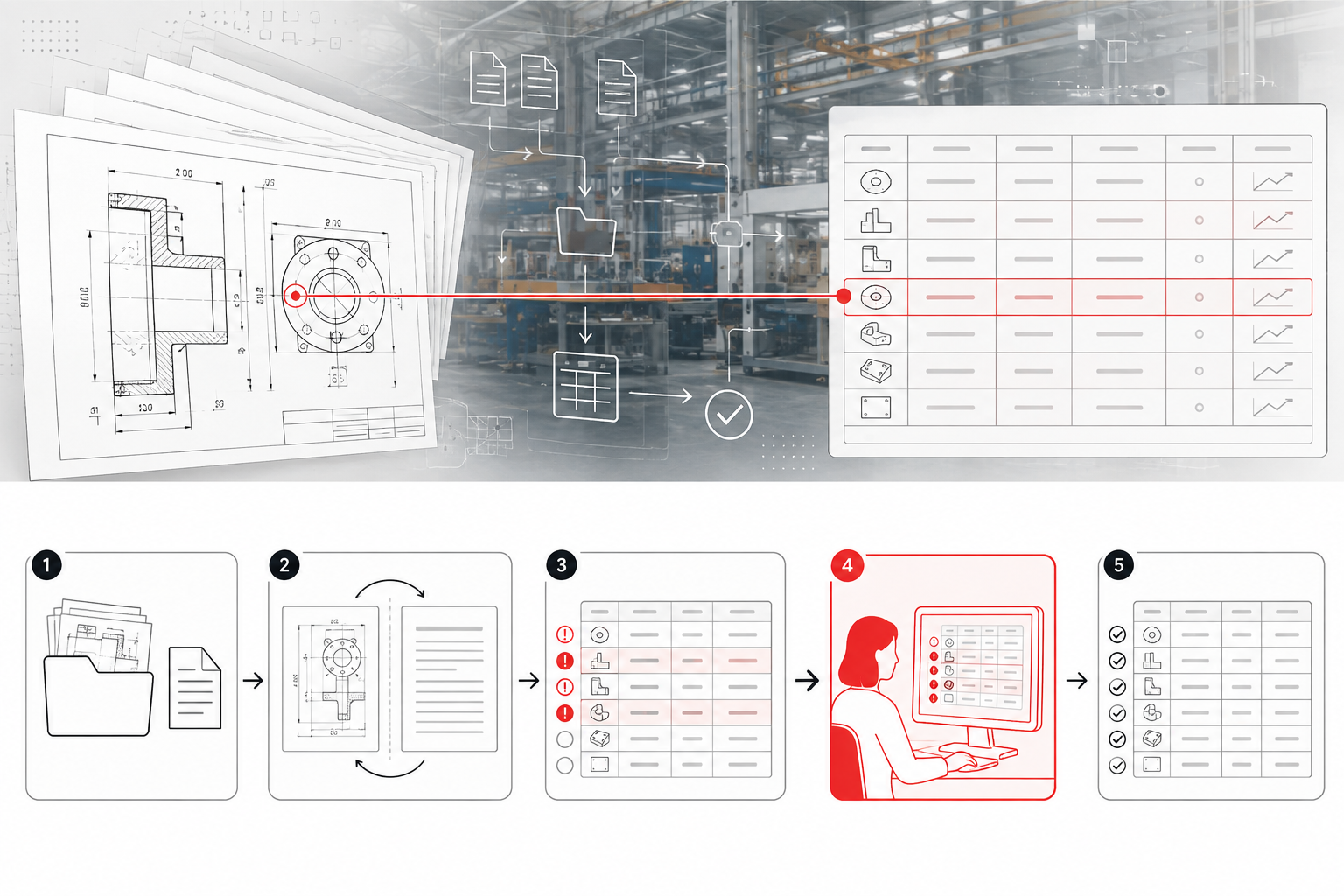
The tender folder goes in as a batch. Every page is read twice, once as text and once as an image. Only the flagged rows go to a person.
The buyer’s side of the same document
Turn the table around, and the document problem looks familiar.
A purchasing team also has to turn incomplete source material into structured decisions: part descriptions, supplier requirements and shortlists. Much of that work is still drafted by hand, often for parts the team may not even end up sourcing.
The database problem is just as practical. A sourcing list may call a company a “manufacturer,” but it may not say whether that company runs its own plant or simply resells someone else’s output. Getting that wrong can waste an entire sourcing round.
The same kind of system, pointed the other way, can draft the description, structure the requirement set and flag which suppliers look like real producers. The buyer still confirms. Nothing goes out on the model’s word alone.
What owners actually ask for
By the time owners describe the quoting problem, the request is rarely just “add AI.” What they are really asking for is more practical, and it usually comes down to the same three concerns.
“We want to own it.” No licences, no per-seat fees that climb every year, no supplier who can raise the price because switching is impossible. This fear is bigger than most vendors admit, and it is worth reading what vendor lock-in really costs before signing anything.
“Small steps, and we want to see it working.” Many of these owners have been burned already, either by a system that was never finished or by two years of paying for development that never arrived. What they dread is not the price of the first step. It is repeating that experience, and having to explain their business from scratch to yet another supplier who does not understand it.
“It has to work with what we have.” Custom manufacturing ERP integration in a mid-size factory means an accounting system such as Pohoda, an on-premise Windows server, and IT handled by a local firm. Not a green field, and not a cloud-only stack. Sometimes the honest answer is that the old system has to be rebuilt first, which is a project in its own right, as with this legacy platform rebuilt for the web.
The way we answer those concerns is practical. A developer is part of the conversation from the start, not brought in after the process has already been translated into a brief. They sit with the people who actually prepare the quotes and go deep into how the work happens today: where the drawings arrive, where the prices live, who checks the output, and what has to stay human. Only then does it make sense to decide what software should do.
For manufacturers, quoting is often the first workflow to structure. Once the quoting and sourcing data is reliable, other automation questions become easier to map — from workflow automation to digital twin and intralogistics.
The next quoting advantage will not wait
The lesson across all of these examples is simple: the best first automation step is usually not the most impressive one. It is the repeatable, high-volume part of the quoting process where experienced people spend time moving information from documents into structure.
The forecast is just as practical. When a technology becomes cheaper and easier to apply, it does not stay a future topic for long. A year ago, this kind of automation was still hard to justify for many manufacturers. Today, a competitor can start testing it on real tenders in a focused first step. That does not mean every quoting process should be automated immediately, but it does mean the change is too big to ignore.
What was hard to justify a year ago can be a competitive advantage today.
If you recognised your own quoting desk in any paragraph above, that is the place to start. We will map the process with you, point at the step with the highest volume and the lowest judgment, and tell you honestly whether it is worth automating yet.
Frequently Asked Questions

New Articles
New blog posts you may be interested in
Finance + Operations Alignment: What Actually Improved
When finance and operations run in separate realities, companies usually pay twice, first in time, then in errors. This case explains what improved after aligning dispatch, document flow, and invoicing readiness.
Read more
What Changed After Moving to Reservation Lifecycle Control
This case outlines practical change after moving from volume-push behavior to controlled reservation lifecycle management. The goal was not another dashboard. The goal was to change operational decision quality over time.
Read more
Compliance in Dispatch: Rules for Certification-Safe Assignment
Compliance in logistics is not only document control. It is daily assignment logic, whether specific equipment can carry specific material on a specific route. If this knowledge lives only in dispatcher memory, risk scales with volume.
Read moreRead also
Recommended reads for You

How companies lose control: too many tools, too many Excels, too many versions of the truth
Many companies don't screw up their digitalization by doing nothing. Quite the opposite. They gradually buy a series of tools, each of which solves a small part of their operation. But over time, they discover that instead of one functional system, they have fragmented processes, unreliable data, and people who keep their own Excel spreadsheets to themselves just to be safe.
Read more
Why Do Digital Transformation Projects Suffer such High Failure Rates?
Digital transformation is a priority for many companies, yet most initiatives still fail to deliver the expected results. Based on Moravio’s hands-on experience and insights shared by Dennis Fino, this perspective reflects what teams often overlook long before technology becomes the issue.
Read more
Build the Right Hotel Software and AI CRM System That Works for You
Helpful insights from our project manager Hsinyu Ko for hotels that want better software that truly fits how they work. Based on our experience from software projects.
Read moreMore context helps
Describe the situation
A few useful details help us prepare: who is affected, how the work happens today, what has already been tried, and why this matters now.