
Hardware decisions run on gut feel.
A new line, racking system or AGV fleet costs millions, and the business case comes from the equipment vendor's own slides.
Digital twin & industrial simulation
Warehouse simulation · Production & machine twins · Scenario comparison · 3D & physics modelling
Model a warehouse, production line or machine using real operating data and engineering rules. Compare layouts, capacity, equipment and process changes before you commit to them on the floor.
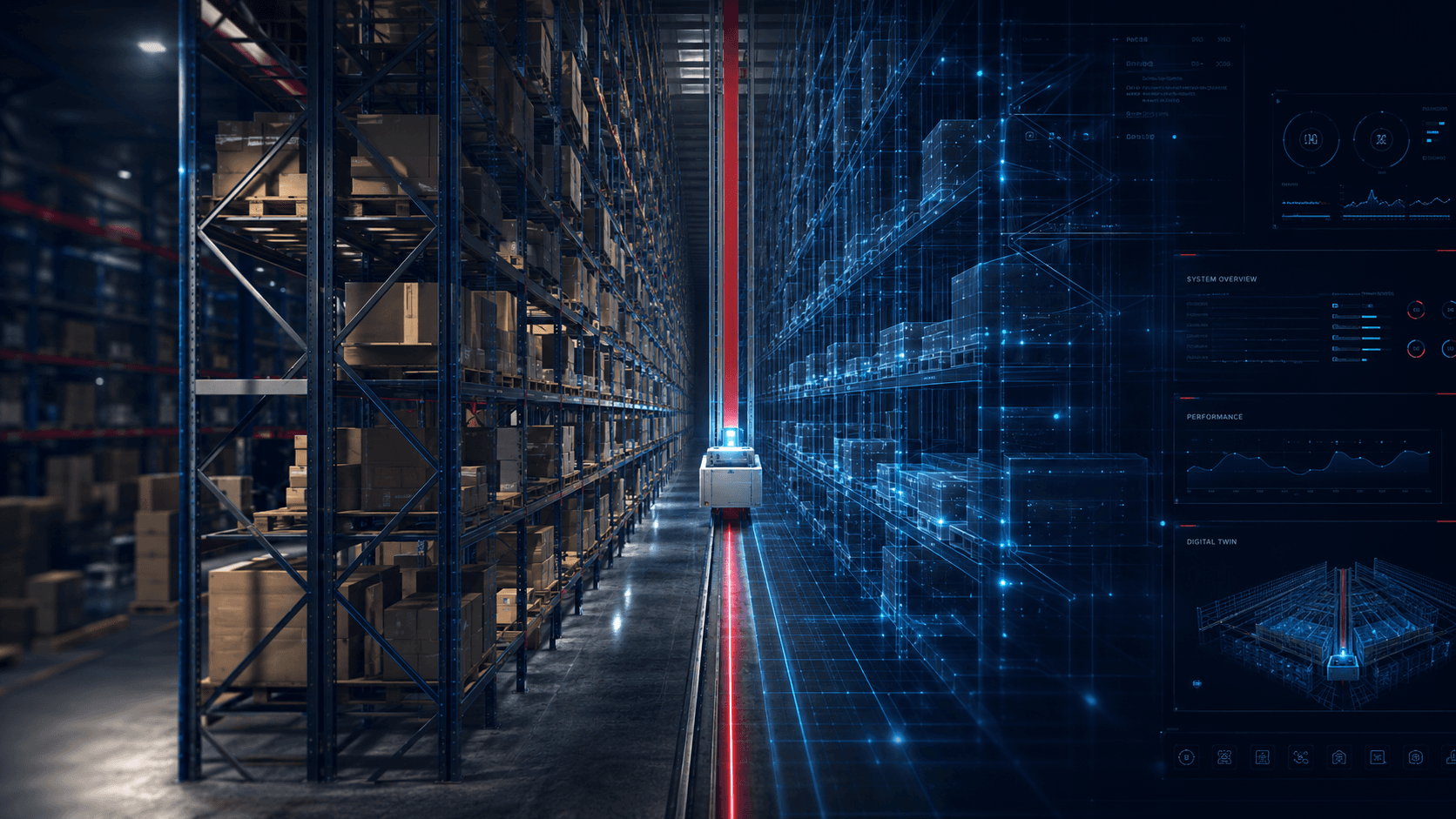
Is this your situation?
Will one more press remove the bottleneck or just move it? Can the current forklift fleet handle the seasonal peak? Today these questions get answered by gut feel and vendor brochures.
A new line, racking system or AGV fleet costs millions, and the business case comes from the equipment vendor's own slides.
The only way to try a new material flow is to rearrange the hall and hope. If it fails, production pays for the experiment.
Stock levels sit in the WMS, orders in the ERP, throughput in a report from last month. There is no live picture of how material actually moves.
Shift plans, buffer sizes and routes are set by experience. The experience is real, but it retires with the person.
The seasonal wave is known in advance, yet every year it produces the same firefighting, overtime and delayed orders.
What you can simulate
Compare aisles, racks, buffers and storage configurations.
Model receiving, picking, routing and dispatch under real order volumes.
Test cranes, conveyors, AGVs or forklifts before changing the physical setup.
Check throughput, peaks, shifts and future volume against the current system.
Find bottlenecks and compare line changes against cycle-time and output targets.
Model movement, handling times, utilisation and operating limits.
Measure what another machine, carriage or equipment upgrade changes.
Compare shifts, sequencing, buffers and higher production volumes.
Real project · automated warehouse
For a European manufacturer of automated warehouse systems, we built a configurable 3D warehouse and crane model with a physics-based simulation core. The team can compare layouts, operating strategies, maintenance scenarios and hardware changes before the physical system is built.
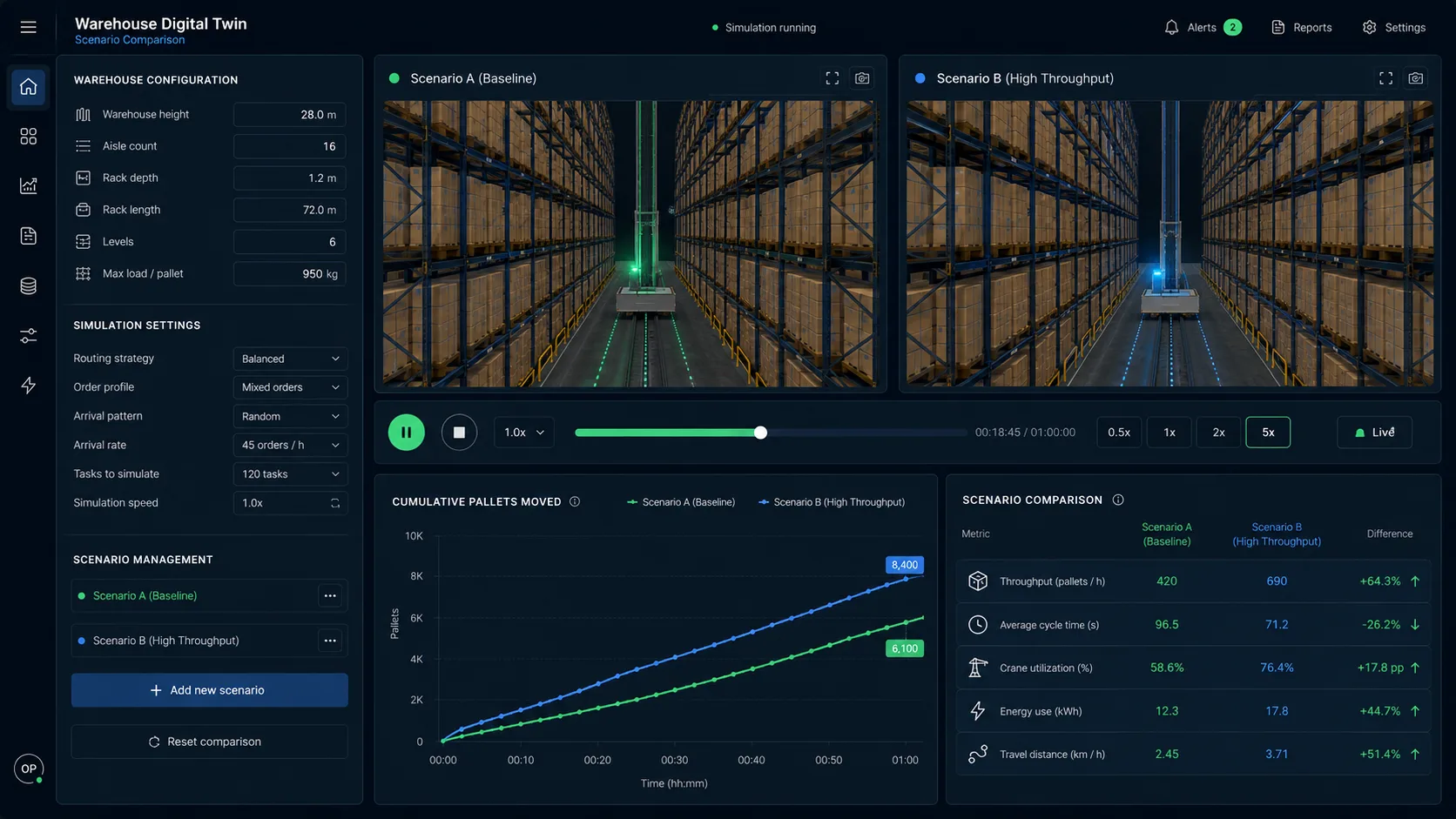
*Simulation outputs on a modelled warehouse.
Read the Case StudyWhere digital twins create value
Compare layouts, equipment and capacity before a physical change.
Configure a customer-specific system, calculate performance and show it in 3D.
Explore Product ConfiguratorsConnect operational data to track throughput, flow and exceptions.
Compare downtime and maintenance scenarios before a failure becomes expensive.
How we build your digital twin
We define the process, machine behaviour, constraints and the question the model needs to answer.
We use operating data and engineering rules, then check the model against a known process or historical period.
Change layouts, equipment, strategies, shifts or volume and compare the outputs.
Use the model for the decision at hand, then connect live data or add modules where they add value.
Data & integrations
Existing systems stay in place · On-premise available · Sensors when useful · Client-controlled data
A useful first model can often start from order history, stock movements, layout drawings and shift data. Your ERP or WMS stays the source of truth. Sensors are added when live machine data changes the decision.
Why Moravio
We define the decision first, then build the model around it.
The people who design the model join the technical conversations and can explain how each calculation works.
Moravio sells software, not warehouse hardware or production equipment. The model can compare options without tying the answer to one equipment vendor.
The solution can run on your infrastructure and work with the systems you already use. The code and repository stay with your team.
FAQ
More context helps
A few useful details help us prepare: who is affected, how the work happens today, what has already been tried, and why this matters now.