In short
Whether to use AI in a company is a settled question. What remains open is how much you can rely on it.
The real risks are nothing like disaster films. They are operational: a price you do not set, a supplier that can change or switch off a model, energy, people who forget how things are done by hand, data, and liability for mistakes.
The price of a token is not the price of finished work. AI is getting cheaper, and it can still cost a company more.
It makes a difference whether a system runs on AI, or whether AI only helps to build it and speeds up the work.
Using AI is a calculated risk. Counting on everything running smoothly is a gamble.
Hardly anyone questions the cloud or e-mail today. Yet there was a time when companies had much the same debates about them as they now have about AI. Whether AI belongs in company processes and systems is no longer the main question for many companies. What matters more is what you can rely on it for, which tasks to hand over to it, and whether you can move to another tool or approach when conditions change.
And even though we treat it more and more as a natural part of systems and of their development, it is worth looking at the risks it brings into companies. Those we have already lived through in its short history, and those that are only potential for now, but far from unlikely.
Using AI is no longer a question for the IT department. It is above all a business decision. That is why it often lands on the desk of people who have so far met technology only at the edges. I will not write about startups that have AI at the core of their business. I am writing for companies that until now have run on Excel, binders and the phone. They can no longer pretend the technological revolution is not happening, and they may feel they are missing the train. They just do not know where it is coming from, where it is going or how fast.
At Moravio we work with AI day in, day out. We know its limits and its magic, and we are pragmatic about using it. We stopped talking only to IT departments a long time ago. Mostly we sit with the people who make decisions in companies and work out how to speed up the business, where software plays a part in that, and where AI does.
AI as part of the infrastructure
Companies outside the IT sector have so far worked with a ready-made solution they bought (ERP, CRM, accounting, design software and the like), with a solution developed for them, or with a combination of both. And with a pile of manual work in between. They pay for product licences, per-user licences, development, maintenance, fixes, changes, servers, hardware. All of these are costs that are fairly easy to picture and to plan. The more careful companies also work out whether the investment pays off: how much more efficient the work has become, how many person-hours they have saved, whether revenue or profit is growing as a result.
Then AI arrived, and questions came with it. Are we doing everything as efficiently as we could? And how much can we rely on it?
Almost everyone has heard of AI hallucinations by now. I have received AI notes from internal meetings in which I read about our own expansion into new markets (that particular idea was never raised), about staff changes (there were none) or about client requirements the client never mentioned. You laugh, correct it and move on. But AI hallucinations are only the visible part. You notice a mistake in meeting notes when you read them. It is much harder to notice how much your company already depends on AI, how much it really costs, and what would happen if AI stopped working.
That is where the real risks are.
The boring risks
They are not cinematic. No robot will take control of a production line and nobody will enslave us. They are boring, operational, and well known from other fields. That is also why they are so easy to overlook: they are not attractive enough to make the headlines.
Each risk comes with a practical question I would ask myself if I were in management:
Price: How much does a finished order cost you with AI, including checking and corrections?
Supplier: What stops in your company if a model disappears for three weeks or starts behaving differently?
Energy and regulation: What will you do when the price or the rules change for a service you do not control?
Your own servers: Who will pay for them, manage them and restore them after an outage?
People: Who in the company can still carry out the process without AI, and do you need to keep that option?
Data: Do you know which tools your people use and what they put into them?
Liability: Who decides what AI may do on its own, and who checks its outputs?
1. How much does AI really cost you?
With an ERP you know how much you pay for a licence per person per month. With AI you pay for tokens, the small pieces of text a model reads and writes. And this is where the paradox begins. Tokens have been getting cheaper over the long term, and dramatically so: according to the Stanford AI Index 2025, the price of querying a model with performance comparable to GPT-3.5 fell from 20 dollars per million tokens in November 2022 to 0.07 dollars in October 2024, a drop of more than 280 times.
That is a sharp fall in the price of computing, but on its own it does not tell you what finished work costs. A company may start with short queries, later send whole contracts and long documents to AI, use more powerful models and let the system process a task in several steps. In the end you still have to count human checking and corrections. A pilot for five people may consume very little. A whole company with long documents, repeated attempts and several automated steps may have completely different economics.
Even the way text is counted in tokens can change. For its Opus 4.7 model, Anthropic stated that the new tokenizer may use roughly 1.0 to 1.35 times more tokens for the same text than the previous version. The price per token stayed the same, but the bill for the same work can go up.
And a price list can also change by plan. When it launched the Sonnet 5 model, for example, Anthropic announced that the introductory price would end on 31 August 2026 and that the price would rise by 50 percent from 1 September. In August, however, it announced that it would keep the introductory price permanently and that the planned increase would not take place. That is good news for customers. It is also a concrete example of how a price a company plans with can change before the change itself ever happens.
The price of a token is not the price of finished work. So alongside the supplier's price list, track the cost of a completed and checked process as well.
2. Can an AI model disappear overnight?
A model can disappear, stop being available in a certain plan, or be replaced by the supplier with a new version. And a rule the supplier does not control can change too.
In June 2026 we were writing to each other in the team that we should use Anthropic's new Fable model while it was included in the subscription, because it was expected to be billed by usage from 22 June. Three days later, on 12 June, Anthropic suspended access to the Fable 5 and Mythos 5 models. It was not a whim of the company. Anthropic was responding to export restrictions issued by the US government. Access to Fable 5 returned on 1 July.
For us it affected only experiments, because we switch models according to what we need and what is available. But imagine that preparing quotes or planning production depended on one particular model.
A complete suspension is not the only possibility:
A forced version change: The supplier retires an old model and the company has to move to a new one, even though it changed nothing itself.
The model works, but answers differently: A new version may assess a complaint differently or pull a different figure out of a contract. Technically the service is running, but the business result can change.
A tool update: We have seen a chatbot over company documents that lost its connection to both the model and the documents after a tool update. The client changed nothing, and the chatbot still stopped working.
A change in commercial terms: A feature can move to a more expensive package, and the supplier can change the price list or shut down a small tool that holds a company's entire workflow. We wrote about how a convenient supplier can turn into a trap in our article on vendor lock-in.
3. Who else influences the price of AI?
Besides the supplier, it is also influenced by the infrastructure AI runs on and by the rules that governments set.
Energy. AI runs in data centres that need electricity, cooling and other physical infrastructure. The International Energy Agency estimates that the electricity consumption of data centres will grow from 485 TWh in 2025 to roughly 945 TWh in 2030. The European Commission states that the consumption of data centres in the EU will grow from 68 TWh in 2024 to 114 TWh in 2030. That does not automatically mean AI or electricity will become more expensive across the board. It means that the availability of AI depends on a growing physical infrastructure that different industries may compete for.
The state. At the end of October 2026, the French National Assembly adopted an amendment to the 2027 budget that introduced a charge of 0.055 euros for every gigabyte of data that content providers send to French users. Five days later the deputies rejected the entire revenue part of the budget, and the proposal fell with it. It was not a tax on AI and it did not become law. But it shows that taxing digital data flows is already being seriously considered, and also how quickly such rules can appear and disappear.
A tax on AI is still only a scenario. We do not know whether or when it would come. But it is sensible for companies to expect that the price of a digital service can also depend on decisions that come from outside the supplier.
4. Will your own server help?
Your own server can give some companies more control over data or availability, but it also moves more responsibility onto the company itself.
Hardware for AI depends on chips and memory, whose prices change with supply and demand. According to TrendForce, contract prices of conventional DRAM rose by up to 98 percent in the first quarter of 2026 compared with the previous quarter, and a further rise of 58 to 63 percent was expected in the second quarter. For the fourth quarter, TrendForce forecasts a rise of 10 to 15 percent for DRAM and 15 to 20 percent for NAND. These are contract prices of memory, not a direct forecast of the price of every server. The memory maker SK Hynix also indicates that the shortage may last until 2030.
Running your own infrastructure also means administration, security, backups, a recovery plan and people who understand it all. A new model may require further testing and sometimes investment in hardware. So it makes sense to compare the total cost and the benefit of control with the risk the company is trying to limit.
5. What if AI works exactly as it should?
Then a less obvious risk can appear: people gradually forget how to handle the process without AI. For some tasks that may not matter. Elsewhere the company finds that its emergency procedure exists only on paper.
Loss of operational know-how: If AI prepares costings or quotes over a long period, the people who knew how to do it by hand may leave or forget how.
A bigger impact from a single mistake: A person can catch a wrong draft. An agent with permission to act on its own can send the same mistake to a hundred customers or write it into hundreds of records.
An apparent backup: Two different AI tools are not necessarily a real backup if both use the same model or infrastructure.
For every process it is therefore good to know whether a manual procedure makes sense, who can carry it out and how quickly it can be restored. And also who checks the AI output before it goes to a customer or changes data in a company system.
6. Where does your data go?
Often somewhere other than people in the company realise.
People put data into AI that does not belong there. In 2023, Samsung employees uploaded source code and other internal information to ChatGPT so that it would help them with their work. Samsung then restricted employees' use of generative AI tools. In companies it may not be clear which tools people use on their own accounts and what data they send to them.
Data is processed under the supplier's terms. Whether and for how long data is stored, whether it is used for further training and where it is processed depends on the plan and the contract. The terms of personal and business versions can differ. For personal data of customers and employees, GDPR also has to be dealt with.
An AI assistant can be abused. If it has access to e-mails, documents or company systems, its behaviour can be influenced by a malicious instruction hidden in a document or a message. This type of attack is called prompt injection. The risk grows with the data and permissions the assistant has.
Do you know which AI tools your people use and what they put into them? And do you have a procedure ready in case data leaks?
7. Who pays when AI makes a mistake?
The company that used the AI. Not the AI supplier.
When AI sends a customer a wrong quote, assesses a complaint incorrectly or rejects a job applicant, the company that used it is responsible. AI suppliers usually limit their liability considerably in their terms. And legislation is changing quickly in the meantime:
Software as a product. EU member states must transpose the new Product Liability Directive by 9 December 2026. Under it, software including AI counts as a product, and liability for its defects applies even without fault. It concerns products placed on the market from 9 December 2026 and damage caused to people, not to companies. Anyone who builds AI into their own products or services should have it on their radar.
The AI Act. Transparency obligations have applied since August 2026, for example that people must know when they are communicating with AI. Stricter rules for high-risk uses, such as selecting employees or assessing creditworthiness, will apply from December 2027 after this year's postponement.
Third-party content. AI output can contain someone else's protected text, code or image. Whoever uses it is responsible.
Insurance. It is worth checking whether your policy covers damage caused by AI.
Company management cannot pass this responsibility on to IT. The law requires management to act with due managerial care, and deciding where AI may act on its own and who answers for it falls squarely within that remit.
Who in your company is responsible when AI makes a mistake with a customer? And is it covered in your contracts with suppliers and with customers?
Does it make sense to avoid AI because of this?
No. What makes sense is knowing where in the company it brings enough benefit and what dependency that creates.
Cloud services and other technologies that companies run on today went down a similar path. The risks did not disappear. Companies learned to manage them, for example with backups, availability agreements and the option to move to another provider. AI does not have to be a reason for panic either. But it is a reason for companies to set rules for its use in good time.
In July 2024, a faulty update of CrowdStrike security software hit roughly 8.5 million Windows devices, according to Microsoft's estimate. That case had nothing to do with AI, but it shows well how far-reaching a change in commonly used digital infrastructure can be.
So the question is not whether to use AI because the competition does. It is about which activities it changes in speed, price or quality so much that ignoring it weakens the company. In some places the answer will be AI. In others it will be plain automation, connecting two systems, or fixing a process that AI would only speed up, mistakes included. According to our survey of companies' AI readiness, most companies are also not yet ready to deploy AI straight away.
Using AI is a calculated risk. It means knowing what can change, how much an outage would cost and which measures are proportionate for a given process.
Does your system run on AI, or does AI only help it?
In my view this is the most important distinction in the whole article, because the risks look different depending on the role AI plays in the company.
AI as a function of the system: In live operation, AI reads invoices, sorts complaints, prepares quotes or answers customers. When it goes down, gets more expensive or changes, some steps stop working or start producing mistakes. The company needs to know what stops at that moment and how the process continues safely.
AI as a helper in building and improving systems: AI helps to design, program, test or document a system, but the finished system does not need it for normal operation. When a development tool goes down, work may slow. The operational system keeps running.
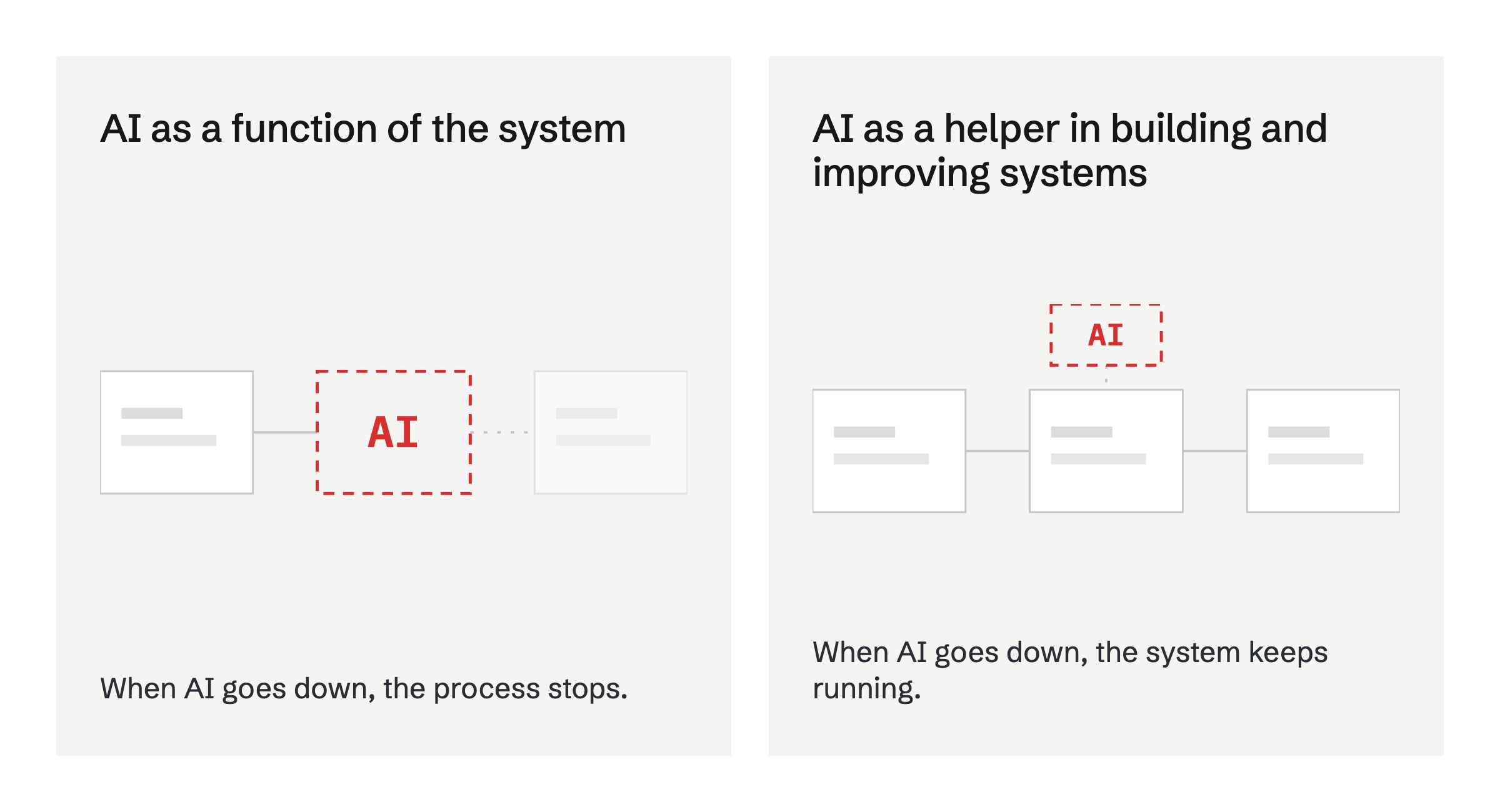
Most companies can use both. For every function it is important to know whether an AI outage stops operations or only slows the work. If a process runs on AI, that should be a known fact, and it should be handled accordingly.
How many of your processes would stop if AI went down for a week tomorrow? And how many would only slow down?
How do you build a system that survives an AI outage?
Start by finding out what role AI plays in the process and what happens when it is no longer available. Where operations can continue by hand, the emergency procedure has to work in practice too. Where AI is the very basis of the service, what matters is a safe stop, preserved data and a recovery plan.
In practice, six things help:
The system can carry on without AI, even if more slowly. If the model goes down, automatic quote preparation may stand still while orders, price lists and approvals remain available. Work can be queued or passed to a person. The emergency mode has to have enough capacity and has to be tested.
Data and process rules stay in company systems. If a supplier's tool is shut down, company know-how should not disappear with it. We explain why to start with data and APIs in the article Data & APIs Before UI.
The model can be replaced without rebuilding the whole system. A backup makes sense only if it does not use the same model or infrastructure as the main solution.
Costs are tracked continuously. Count the cost of completed work including human checking, and verify that AI is delivering the expected improvement.
AI agents have only the permissions they need. If they can change data or communicate with customers, define where human approval is required.
People know the process outside the automated path as well. Processes should be described so that a person can take them over, if their importance and the cost of an outage call for it.
Is vibe coding a problem?
Vibe coding can be useful for testing an idea or building a prototype or a small internal tool. The risk arises when a prototype becomes a critical system that nobody understands and nobody can verify, secure or maintain. Such projects then often end up as a project rescue.
My colleague Šárka Skopalová has written a separate article on vibe coding. In companies we have seen a case where a feature created with AI made it all the way to the customer without sufficient checking. A complaint, a fix and delayed invoicing followed. Creating code quickly can be useful, but before it is deployed in an important process, someone has to verify what the code does, how it handles data and who will maintain it.
We have also come across a case where a potential client did not want to continue working with a company after concluding that its website had been put together in a hurry with AI. Using AI to build a website does not have to be a problem in itself, but the quality of the result and the way the company presents it affect trust.
It is also good to distinguish two things: AI can help to create software without that software needing AI to run. In the first case the main risk is the quality and maintainability of the code. In the second it is the dependence of operations on the availability of a model.
How we approach it at Moravio
We have been building and connecting the systems companies run on since 2011. We bring AI into them as well, but we do not start with the question of which model to deploy. First we need to understand how the company works and where the biggest benefit is. Then it is possible to decide where AI helps, where automation is enough and where it is better to fix the process itself. Sometimes the best fit is an off-the-shelf solution, and we say so. Companies can start with an AI audit, which helps to determine where AI pays off and how to handle the related rules and security.
We work the same way ourselves. Our developers use AI every day, in the editor and in the terminal, and choose the model according to the task. One suits one job better, another suits a different one, and when the price or quality changes, they switch. AI helps us build, but what we build does not run on it. Code written by AI is checked by a person, and a vibe-coded prototype never goes straight into production. And we still use AI meeting notes. We just actually read them before we act on them.
Conclusion
AI will neither save us nor destroy us. It is a tool. You rely on tools, but you do not build on them.
Do you know which of your processes run on AI and which ones it only helps? When the conditions around AI change (and they will), you will either be adjusting one tool or rescuing an entire company process.
Would you like to walk through what would happen in your company if AI went down for a week tomorrow? Get in touch. And if you are still working out where to begin, have a look at AI and digitalisation: where to start so that it makes sense.